Fight the environment
- High water demand or complex closed-loop cooling
- Exposure to storms, floods, fires, grid congestion, and politics
- Heat, noise, and land-use conflict near communities
- Expansion tied to local permitting and power availability
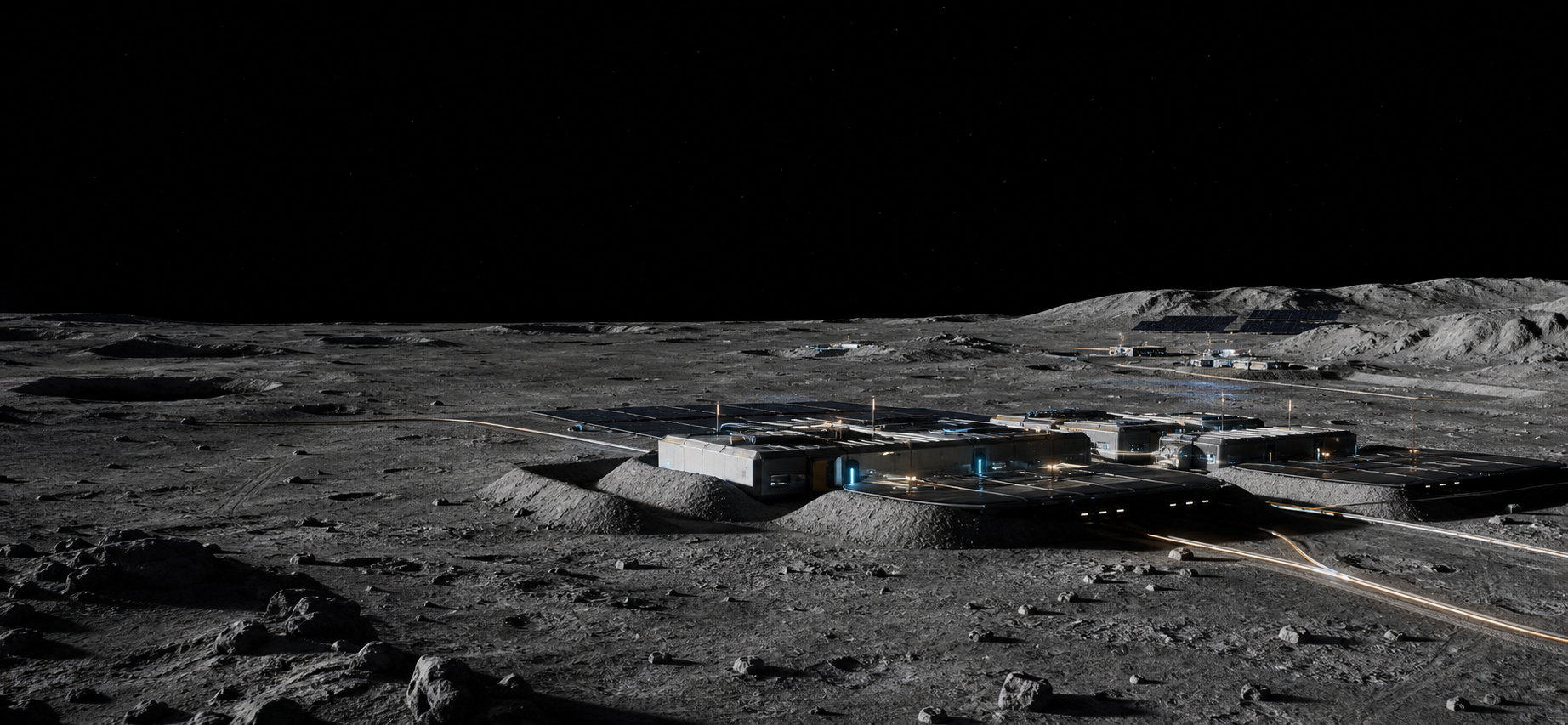
Compute beyond weather, borders, and heat islands
Darkside Data Center is a proposal for high-density lunar compute campuses: shielded under regolith, powered by continuous ridge-line solar, and cooled by the cold vacuum that terrestrial infrastructure spends billions trying to simulate.
Why leave Earth
AI-scale compute wants cheap power, extreme cooling, geopolitical stability, and room to expand. On Earth, those needs collide with water rights, transmission constraints, heat rejection, land use, noise, and the fragility of regional grids.
A lunar facility changes the constraint set. The far side offers isolation from radio interference, no weather-driven downtime, no biosphere to heat or drain, and a vacuum environment that can make radiative cooling the primary thermal design instead of an expensive afterthought.
Lunar vs terrestrial
How it works
Server modules sit in pressure-stabilized vaults covered by meters of sintered regolith for radiation and impact protection.
Heat pipes move waste heat to articulated radiator fields that face deep space, turning vacuum into a thermal advantage.
Solar arrays, fuel cells, and stored hydrogen bridge lunar night while high-illumination sites keep generation predictable.
Laser links route traffic through lunar orbit and ground stations, reserving local inference and batch jobs for latency-tolerant workloads.
Operating model
Lunar compute does not need to replace every data center. It starts where latency matters less than capacity, resilience, and energy certainty: model training, scientific simulation, archival processing, rendering, cryptographic workloads, and autonomous lunar operations.
Training runs can checkpoint locally, sync gradients in scheduled windows, and use lunar power/cooling advantages for sustained high-density operation.
Deployment path
Validate optical networking, hardened servers, autonomous repair routines, and radiation-tolerant storage in lunar orbit.
Land containerized compute, regolith shielding equipment, compact radiators, and a robotic maintenance bay.
Scale power fields, thermal loops, spare-part manufacturing, and Earth-lunar traffic scheduling for commercial workloads.
Field notes
Long-form guides to the systems, constraints, and technologies shaping modern compute.
A guided tour through the power, cooling, computing, storage, and networks behind cloud and AI infrastructure.
A balanced examination of data-center construction, including electricity, water, land use, noise, pollution, taxes, jobs, and common misconceptions.
Mission brief